
Matara, Sri Lanka: The South Coast's Most Historically Layered City, Still Largely Undiscovered
Few people have heard of Matara as a destination, yet the southernmost reaches of Sri Lanka have a history as layered as any city on the island. Portuguese, Dutch, and British each left their mark here. So did the ancient Kingdom of Ruhuna, Arabian spice traders, and a river that has been feeding this coast for millennia. Most tourists drive straight through. That is their loss. Matara's name translates as "Great Ferry," a reference to the wide seaport and river crossing that made this city one of the most strategically important on the southern coast for centuries. Portuguese seafarers built the first fort here in 1560. The Dutch captured it in 1640, built a second Star Fort to protect the first, and turned the city into their most important southern base after Galle. The British arrived and added their own layer. What remains is a real, living city with cobbled colonial streets, a Buddhist temple on a river island, a reef-sheltered beach where sea turtles are very regularly spotted, and Dondra Head, the southernmost point of Sri Lanka, just beyond the city limits.
A Range of Matara Beach Villas by Ceylon Haven
Stays in Matara favour quiet over spectacle. You'll find breezy, open verandas built for watching an uncrowded coastline rather than a busy one, simple whitewashed or timber-clad exteriors that don't compete with the view. Layouts are designed around a slower pace than the more built-up beach towns further north.
This is a coastline where the architecture gets out of the way of the ocean. Your ideal Matara villa is less about scale and more about position, a genuine stretch of quiet beach at the door. At Ceylon Haven, we're ready to help you find the right one from our curated collection of villas in Matara.
Beachfront Matara Villas at the Southern Tip of the Island
Matara's coastline is quieter than the beaches further north, and Villa Tres makes the most of that. A beach villa just beyond the town itself, with its own infinity pool and the ocean genuinely at the door. The layout suits both couples wanting a private courtyard bedroom and young families, thanks to a separate upstairs loft, ideal for kids to have their own space while parents keep the ground floor to themselves.
Frequently asked questions
Check our FAQ for details on this city
Matara is a major city on Sri Lanka's southern coast, approximately 160 kilometres from Colombo. By car via the Southern Expressway, the journey takes around two and a half hours. The coastal train from Colombo Fort runs directly to Matara, which serves as the main southern terminus of the coastal rail line, with the journey taking around three and a half hours and passing through Galle and Weligama. The A2 highway runs through the city, and Matara is the southern terminus of the Southern Expressway Stage 2, making it a major transport hub for the entire south coast. Ceylon Haven can arrange private transfers from Colombo, the airport, Galle, Mirissa, or any point along the south coast for all guests.
Although busy, Matara is not part of the main tourist trail in Sri Lanka and does not see as many international visitors as nearby Mirissa, making it an unbeatable opportunity to immerse yourself in modern Sri Lankan culture away from the crowds of tourist towns. It is a real city with a real population, real markets, real temples, and a colonial history as rich as Galle Fort without the boutique hotel prices that heritage brings. Its quiet streets teem with traces from the past hidden in crumbling structures, age-old names and forgotten stories that reward guests who take the time to walk slowly rather than drive through. Mirissa and its whale watching are minutes west. Tangalle and the far south are under an hour east. Matara is where the south coast still belongs to Sri Lanka.
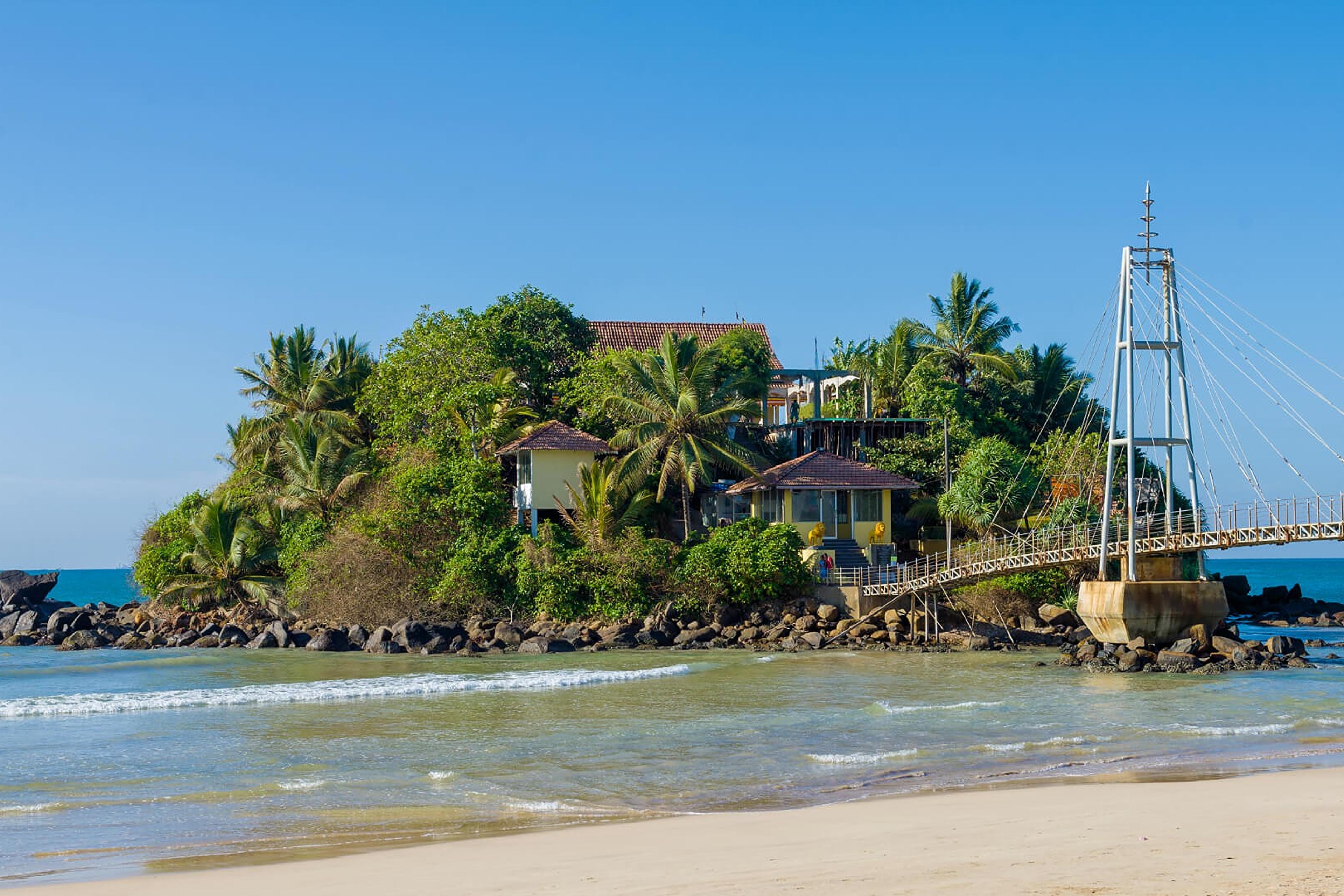
The list is deeper than most visitors expect. The Matara Fort, first built in 1560 and extensively rebuilt by the Dutch, and the hexagonal Star Fort built to protect it from river attacks, together tell the story of three centuries of colonial ambition on this coast. Parevi Duwa, a Buddhist temple on a small island in the mouth of the Nilwala River, is reached by an elegant footbridge and set in attractive gardens housing numerous Buddha statues. Polhena Beach, just west of town, offers reef-sheltered waters where sea turtles are spotted close to shore with exceptional regularity. The Dondra Head Lighthouse, the southernmost point of Sri Lanka, stands a short drive east and is considered one of the oldest lighthouses on the island. And the Weherahena Temple, a vast tunnel temple decorated with paintings of Jataka tales, adds a spiritual and architectural dimension that earns a dedicated half morning.
Polhena Beach is a tranquil, reef-sheltered cove near Matara, highly regarded as one of the safest beaches in Sri Lanka due to its natural coral reef creating a calm, shallow lagoon with minimal waves, ideal for swimming for all ages including children and non-swimmers. The snorkelling in the bay is reliably productive, and though visibility is not always exceptional, turtles are very regularly spotted here. The beach is genuinely uncrowded on weekdays, with a quiet, local atmosphere that reflects Matara's character rather than the tourist-oriented beach strips further west. Sunrise and sunset at Polhena produce warm pink and orange tones across the shallow turquoise water, with the sheltered bay holding calm mirror-like reflections that make the beach feel private even when visitors arrive.
Matara's two Dutch forts represent the most intact colonial military complex outside of Galle on the entire south coast. The Portuguese built the original Matara Fort in 1560 to protect their newly captured town. The Dutch captured it in 1640, extensively rebuilt it, and then constructed the Star Fort on the east bank of the Nilwala River in the shape of a six-pointed star to protect the main fort from any attack coming from the river. The Star Fort is now used as a museum showcasing the history of Matara, while the main fort remains integrated into the life of the city itself, with tuk-tuks passing through its gates and old colonial buildings serving as homes, shops, and offices. Unlike the other coastal forts built by the Dutch in Sri Lanka, the fort at Matara was originally built as an elephant taming and training centre, a function unique on the entire island and one of those historical details that reframes everything you see when you walk through it.
Dondra Head is the southernmost point of Sri Lanka, located just east of Matara, and the lighthouse that marks it is one of the oldest and most photographed on the island. Standing at the very tip of the country, with the Indian Ocean stretching unbroken in three directions toward Antarctica, it is one of those geographic moments that imposes itself quietly rather than dramatically. The lighthouse is operational and the surrounding coastline is genuinely beautiful, particularly in the late afternoon when the light is golden. The Tenavaram temple complex, one of the most historically significant religious sites on the south coast, sits within the same area and is worth combining into the same visit. The drive from central Matara to Dondra Head takes under 20 minutes and is scenic throughout.
Matara's dry season runs from November to April, when warm, sunny weather creates ideal conditions for beaches, snorkelling at Polhena, and comfortable exploration of the city's historical sites. December through March is the most popular window, coinciding with whale watching season in nearby Mirissa and the peak period for the entire south coast. Tourism in Matara itself increases during July and August, when a larger number of domestic holidaymakers arrive, making the shoulder months of November and March to April particularly pleasant for international guests seeking good weather with lower crowd levels. The wet season from May to October brings heavier rain, but Matara's colonial architecture, temples, markets, and inland culture remain rewarding year-round.
Very much so, and for specific reasons that make it a strong choice. Polhena Beach's reef-sheltered lagoon, with its calm, shallow water and minimal waves, is consistently recommended as one of the safest swimming beaches in Sri Lanka for families and non-swimmers. The turtle snorkelling at Polhena is an experience that lands particularly well with children, with turtles regularly spotted close to the shore in shallow, manageable conditions. The city's markets, temples, and colonial forts offer genuine cultural content that engages older children and teenagers in a way that a purely beach-focused destination rarely does. Ceylon Haven's Matara properties are selected with private outdoor space and family-appropriate hosting in mind, and the team can arrange activities, meals, and day trips around your group's specific needs.
Matara sits at a pivotal geographic point. Mirissa and its whale watching are 20 minutes west, placing the full Mirissa experience within easy tuk-tuk range. Tangalle, one of the most beautiful and least visited stretches of beach on the island, is under an hour east. Yala National Park, Sri Lanka's premier wildlife reserve, is reachable from Matara as a full-day excursion, as is the Bundala wetland reserve and the ancient religious city of Kataragama. The hill country, Ella, and the tea estates of the interior are also within a long day's drive. For guests who want to use a single villa as an anchor for a serious south coast exploration, Matara's central position on the far southern tip makes it one of the most practical bases on the island.
Matara's accommodation landscape is dominated by guesthouses, local hotels, and a handful of boutique properties that vary considerably in standard. Ceylon Haven's selection process means every property in the Matara collection has cleared a bar for design quality, hosting standard, and setting that most listings in the area do not reach. A villa here gives you private space, a dedicated team, and a home base from which to engage with one of Sri Lanka's most genuinely authentic southern cities on your own terms. Unlike nearby Mirissa, Matara offers an unbeatable opportunity to experience modern Sri Lankan culture away from crowds, and a well-chosen villa is the right instrument for that experience. You are not in a resort bubble. You are in the city, properly, with everything that implies.
The Haven Journal
Your insider guide to Sri Lanka; where to go, what to savour, and how to experience the island like you actually live here.
Our Partner Philosophy
Not every business makes the cut. And that's the point.
Every partner in the Ceylon Haven Passport network is chosen the same way we choose our villas: with care, with discernment, and with you in mind. We look for the places and experiences that feel genuinely Sri Lankan; independent, characterful, and led by people who take quiet pride in what they do.
If it doesn't add something real to your stay, it doesn't make the list.

Speak to a travel specialist


