
Everyone has heard of Galle. Most people who have heard of Galle have a vague mental image of whitewashed ramparts, a lighthouse, and a street lined with the kind of boutiques that sell beautiful things at prices that suggest the shop owner has strong opinions about their own taste. That image is accurate, as far as it goes. The problem is that it does not go very far. Sri Lanka's southern coast runs for well over two hundred kilometres from Bentota in the northwest down to Tangalle in the southeast, and Galle sits roughly in the middle of it. To experience the south coast through Galle alone is a little like deciding you have understood Paris because you visited the Louvre. Impressive. Correct. Incomplete. This is not a guide to the obvious. It is a guide to doing the south coast in a way that earns the full picture, with enough specificity to be genuinely useful and enough honesty to tell you when somewhere is worth the detour and when it is worth skipping.
Start in the North. Most People Don't.
The logical entry point to the south coast, if you are arriving from Colombo, is Bentota. This is also where most travellers make their first significant error, which is to use Bentota as a base and work southward by day trip. Bentota is a pleasant place to be, with its long beach and the calm backwaters of the Bentota River pulling in different directions. But it is a place to pass through rather than linger in, and treating it as a hub means you spend a considerable portion of your trip in a vehicle going back and forth along a road you have already seen. The better approach is to move progressively south, staying in each area long enough to understand what it actually offers. Bentota gives you the river, the beach, and a particular kind of relaxed, old-school resort energy that the coast further south has largely outgrown. Balapitiya, just south of Bentota, gives you the Madu River mangroves, a dense tangle of waterways and island temples that rewards an unhurried morning far more than the two-hour speedboat version most operators sell. Hikkaduwa, which has been a backpacker fixture since the 1970s, is worth knowing about for its reef snorkelling and coral gardens, though it asks for some tolerance of its own considerable busyness. This northern stretch is best appreciated for what it is: a coastal preamble. It sets the pace before the south coast proper begins to reveal what it is genuinely capable of.

The south coast asks something of you. It asks you to slow down enough to notice where you actually are.
Galle: The Part Everyone Gets Right and the Part They Miss
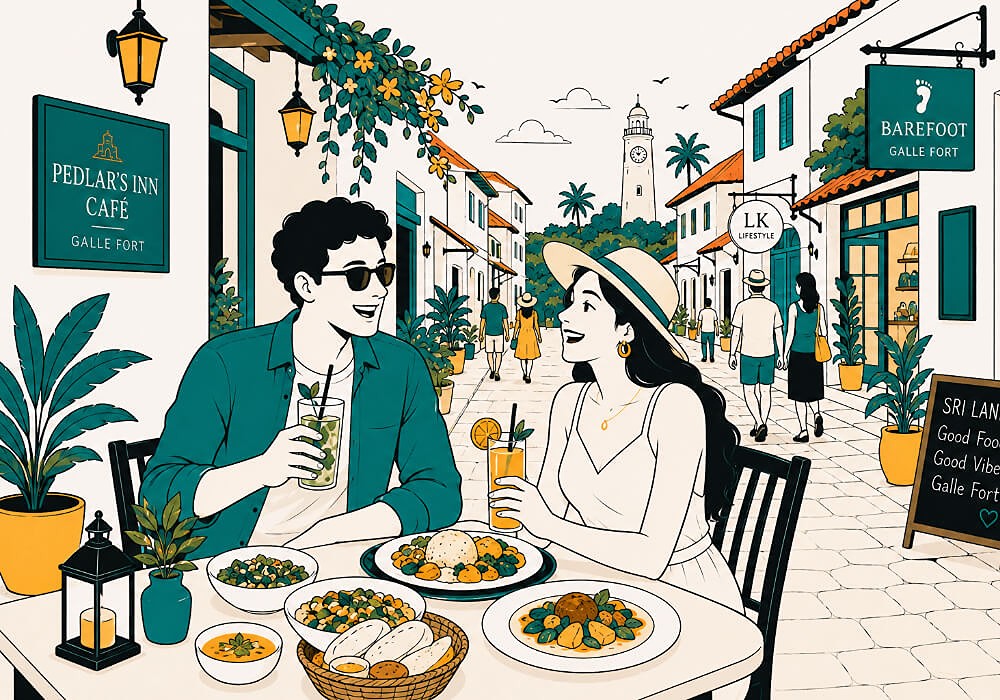
Galle Fort deserves its UNESCO listing and its reputation. It is one of the best-preserved examples of European colonial architecture in Asia, a walled city that the Portuguese started in 1588, the Dutch substantially rebuilt and expanded through the seventeenth century, and the British left largely intact when they took over in 1796. Walking its cobblestone streets in the early morning, before the heat settles and the day-trippers arrive, is one of those experiences that makes you understand why people extend their holidays at the last minute. What most visitors miss is that the Fort is now also one of Sri Lanka's most interesting dining destinations. The culinary scene inside the walls has matured considerably over the past decade. There are restaurants working seriously with local arrack, the island's own spirit, in ways that would not embarrass a good cocktail bar anywhere in the world. There are chefs making proper use of the extraordinary seafood that comes off these shores daily. There is Italian done well enough to make a Roman defensive. The Fort rewards an evening as much as a morning, and ideally both. The area immediately around Galle, particularly the stretch through Talpe and Habaraduwa toward Koggala, is where some of the coast's most considered villa properties sit. The combination of the Fort's cultural weight and the surrounding coastline's relative quiet has attracted a calibre of property that understands both the place and its guests. These are not villas that happened to end up near Galle. They are properties that chose the location deliberately and designed around what it offers.
Ahangama, Unawatuna, Mirissa: Know the Difference
These three names appear together on most south coast itineraries, often as interchangeable beach stops. They are not interchangeable, and understanding what distinguishes them will save you from arriving somewhere expecting one thing and finding another. Unawatuna is the closest to Galle, a curved bay with calm water and a social beach scene. It swims well and eats well and is genuinely lovely, but it is also the most visited stretch of coast in this section of the south, and it knows it. In peak season, the beach gets crowded in the way that popular beaches in popular places get crowded. Manage your expectations accordingly and you will be fine. Ignore that advice and you may spend your first morning wondering whether you should have gone to the Maldives. Ahangama is a different proposition. It is a surf town in the truest sense: the waves are consistent, the pace is slower, the architecture leans toward open-sided cafes and low-slung villas rather than resort compounds, and the stilt fishermen still appear on their poles above the shallows in the early hours. It has the coastal equivalent of a good neighbourhood: a sense that the people who chose to be here did so for specific, considered reasons rather than because it was the obvious choice. The villa properties in and around Ahangama reflect this. They tend toward the individual and the carefully designed rather than the uniformly polished. Mirissa sits further south and has evolved rapidly over the past decade into a beach town with genuine energy and a whale-watching season, running from November through April, that draws visitors who have no particular interest in anything else on the coast. Blue whales and sperm whales in good numbers, at relatively close quarters, in warm water: it is a compelling proposition. Outside whale season, Mirissa's beach is wide and swimmable and its restaurants are better than you expect from a place that also caters to the very young and the very budget-conscious.
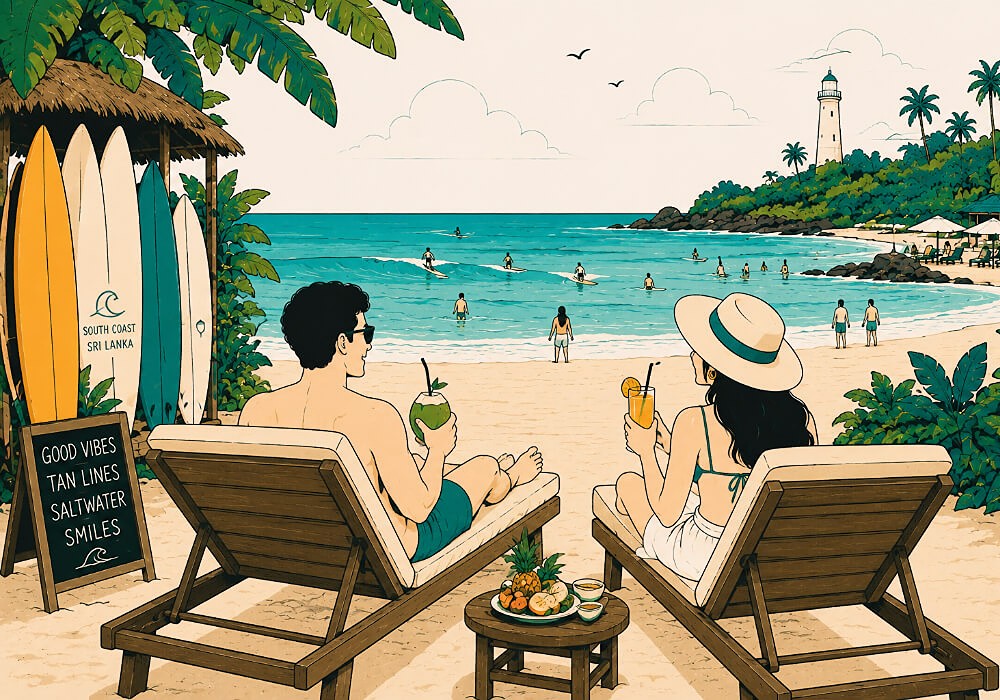
Ahangama has the coastal equivalent of a good neighbourhood: a sense that the people who chose to be here did so for specific, considered reasons.
Hiriketiya: The End of the Road Worth Reaching
Most south coast itineraries stop at Mirissa or Matara. The ones that continue to Hiriketiya tend to stay longer than planned. Hiriketiya is a horseshoe bay tucked behind a coconut grove about ten minutes from the town of Dickwella, and it has become, over the past few years, one of those places that attracts a very specific type of traveller: people who have been to enough places to know what they want and have concluded that what they want is a bay with good surf, genuinely good coffee, and the kind of low-key social scene that happens when a lot of interesting people end up in the same small cove with nothing particular to do. It does not have the cultural weight of Galle or the whale-watching spectacle of Mirissa. What it has is a quality of place that is harder to manufacture and harder to find: the sense that you have arrived somewhere that has not yet been fully smoothed out and packaged for easy consumption. That is worth a considerable amount, and it is not guaranteed to last.
How to Move Between It All
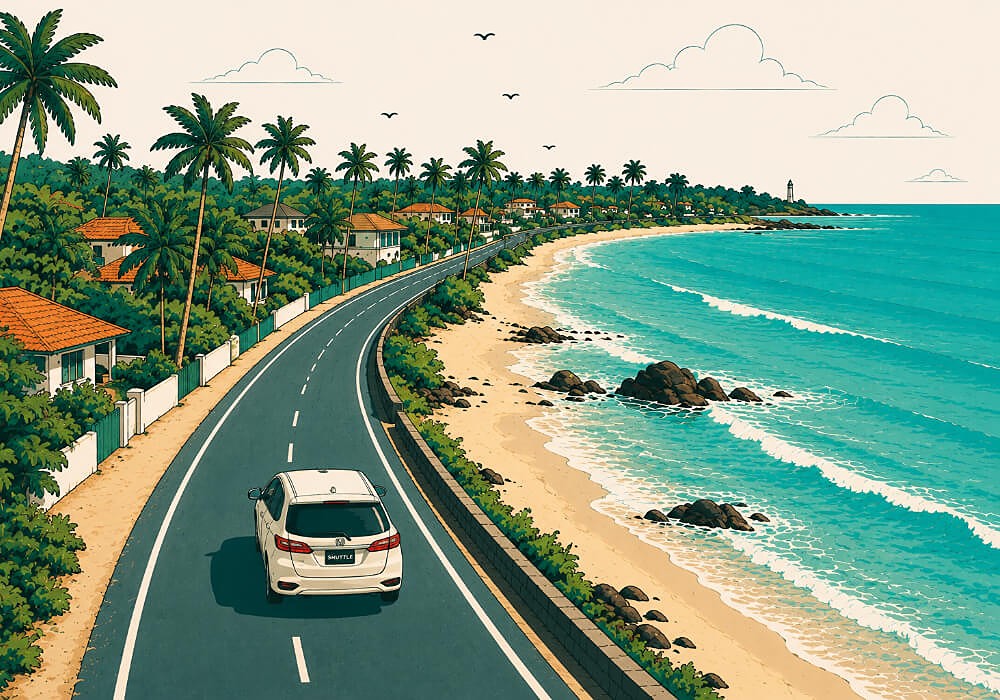
The south coast's great practical virtue is its compactness. Bentota to Hiriketiya covers roughly a hundred and fifty kilometres of road, and the entire stretch is manageable in a single well-planned week without ever feeling rushed. The error most visitors make is underestimating how much the journey itself matters. A rental car gives you freedom and removes any possibility of local knowledge. A tuk-tuk is an experience worth having for short distances and a serious test of patience for longer ones. The best version of moving along this coast is a private chauffeur who knows it, not in the abstract, but specifically: which junction requires a left turn that every navigation app insists is a right, which stretch of the Galle road is genuinely scenic and which is a lorry-laden four-lane highway, and when to pull over because there is something worth stopping for that no itinerary would have included. Ceylon Haven guests who arrange ground logistics through the team get exactly this. The chauffeurs who work with us have spent years on this coast, know the properties in our collection, and carry the kind of practical fluency with the island that makes the difference between a good holiday and a great one. They are also, on balance, more entertaining company than a GPS.
What to Eat and Where the Passport Comes In
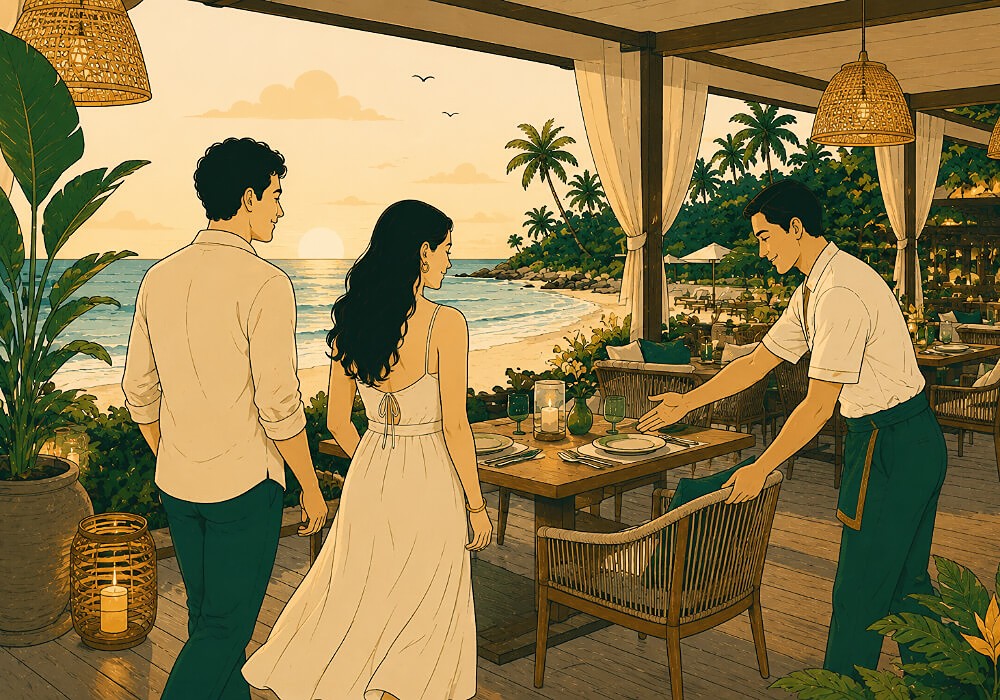
The south coast's food scene has matured significantly and continues to do so. Inside Galle Fort, the options range from Sri Lankan seafood done with real precision to international cooking that uses the island's extraordinary produce as a starting point. Along the coast through Talpe, Ahangama, and Mirissa, there is a growing collection of restaurants and cafes that serve exceptionally good food in settings that make eating out feel like the right choice rather than a default. Ceylon Haven Passport holders have access to a curated network of partner restaurants and cafes near our properties throughout the south coast, each selected because it represents a genuine reason to leave the villa rather than simply a place to eat. This is not a discount scheme bolted onto a booking. It is the result of the same editorial judgment we apply to the properties themselves: something is in the network because it earns its place, and the privileges available to Passport guests reflect what these establishments do best. Your booking confirmation is all you need to access them.
When to Come
The south coast's dry season runs from November through April, when the weather is reliably clear, the sea is calm, and the whale-watching season is at its most productive. December and January are peak months: the coast is at its best and correspondingly busiest. If you can shift to November or February and March, you will find the same conditions with considerably fewer people sharing them. The southwest monsoon runs from May through October. The coast is greener, the sea is rougher, and the atmosphere shifts accordingly. Some travellers prefer it. The villas are quieter, the roads are emptier, and there is a particular pleasure in watching a serious tropical storm move across the Indian Ocean from the right property with the right pool and the right bottle of something cold. It is not the postcard version of Sri Lanka. It is, in certain moods, the better one.
There is a particular pleasure in watching a serious tropical storm move across the Indian Ocean from the right property. It is not the postcard version of Sri Lanka. It is, in certain moods, the better one.
The Point
The south coast is not a checklist. It is not a series of stops to photograph and move on from. It is a stretch of coastline with enough variation in character, pace, and landscape to reward almost any kind of traveller who comes to it with enough time and the right orientation. The right orientation, if you are asking, is roughly this: start further north than feels necessary, move slowly, eat well, spend at least one evening in the Fort, and resist the impulse to turn around at Mirissa. The things worth finding on this coast tend to be just beyond where most itineraries end. Browse the collection to find the right property for your stretch of coast. If you are not sure which stretch that is, the team is.
With love, D. Rabbie